
From document production to structured content, workflows, and governance
Executive Summary
Regulatory Labeling is not “being replaced by AI” — it is being rebalanced. A task-based view (Frey & Osborne, 2013) suggests that rule-based, repeatable work is automated first, while judgment, stakeholder coordination, and accountable sign-off remain human-led.
In Regulatory Labeling, this shift is accelerated by standardisation and structured data (QRD templates, SPOR/IDMP master data, and ePI based on FHIR).
What is changing in practice
- Document assembly & formatting → workflow orchestration (release planning, exceptions, audit evidence)
- Manual proofing → QA automation (rules, tests, quality analytics) with human approval
- Document-centric writing → content architecture (modular components, reuse, traceability)
- Local free text → interoperable product information anchored in standards (ePI/FHIR) and master data (IDMP/SPOR)
In many labeling organisations, day-to-day work still happens as tool-assisted manual processing: Word documents (track changes), email-based handoffs, checklists, and standalone text verification tools (TVT) that flag deviations after the fact.
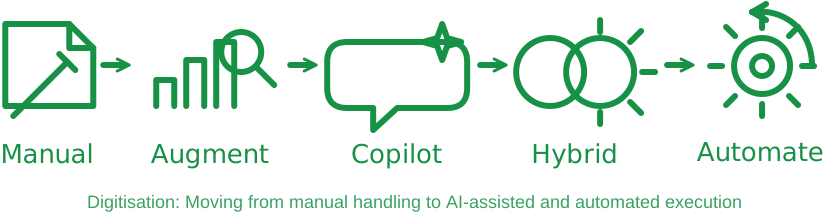
The operating modes below describe how tasks evolve as labeling becomes more digital: moving from document-centric work towards system-led execution, structured content, and auditable workflows.
Most organisations will run a hybrid mix across modes.
Legend (modes):
- AUTOMATE — deterministic rules and pipelines execute checks/transformations (e.g., structure & consistency validation, assembly, version/trace evidence) with repeatable outcomes.
- COPILOT — AI assists drafting and review (suggestions, variants, summarisation), but decisions remain reviewer-owned and must stay anchored to authorised sources.
- AUGMENT — analytics and decision support (impact assessment, readiness signals, risk/effort indicators) improves prioritisation and release decisions.
- HUMAN-LED — accountable judgment & sign-off (policy, exceptions, regulatory interpretation, agency dialogue); defines guardrails for what automation/copilots may do.
New Task Clusters
Workflow & Release Management - AUGMENT
Design and run end-to-end labeling workflows, manage exceptions, and assemble inspection-ready evidence (audit trails, approvals, traceable change rationale).
Run end-to-end labeling changes with impact insights: routing, exception queues, release readiness, audit-evidence completeness.
Secondary: HUMAN-LED for release decisions, risk trade-offs and sign-off.
Content Architecture & Component Governance - COPILOT
Define labeling components (sections, phrases, tables, figures), drive controlled reuse across products/markets, and maintain traceability from claims to authorised sources and variants.
Secondary: HUMAN-LED for component policy, reuse boundaries and accountable wording decisions.
QA Automation & Rules - AUTOMATE
Translate regulatory and quality expectations into executable checks (structure, consistency, terminology, numeric integrity), monitor quality metrics, and continuously improve test coverage.
Secondary: HUMAN-LED for deviation decisions and final approval.
Data Stewardship & Interoperability - AUTOMATE
Validate and maintain identifiers, mappings and referentials. Maintain identifiers, referentials, and mappings to ePI, IDMP, SPOR so labeling content remains consistent across systems (authoring, submission, safety, artwork, affiliates) and is future-ready for ePI/FHIR-based exchange.
Secondary: HUMAN-LED for governance of standards interpretation and master-data ownership.
Governance & Accountability - HUMAN-LED
Define policies for AI-assisted drafting and review, ensure role-based approvals and responsibilities, and safeguard compliance (CSV/GxP), especially where interpretation and risk trade-offs are required.
What to do next (pragmatic steps)
- Decompose work into tasks and classify them as: Automate / Copilot / Human-led.
- Establish a component model for product information (reusable units + traceability rules).
- Implement automated proofing as a first “quick win” (structure + consistency + data checks).
- Build workflow orchestration that captures decisions, evidence, and approvals by default.
How medpharmtec helps
medpharmtec supports labeling organisations in operationalising this transition — without forcing a “big bang” replacement of established practices. We work comfortably in traditional, document-centric environments (e.g., Word-based authoring, controlled review cycles, and tool-assisted proofing such as TVT-style checks) and, where appropriate, help teams evolve towards higher digitisation levels.
In practice, this means combining:
- Component-based product information (modular content, reuse, traceability to authorised sources and variants),
- Traceable proofing / QA automation (rules, tests, consistency and numeric checks with audit evidence),
- Workflow orchestration (release planning, exception handling, role-based approvals, and inspection-ready records),
designed to remain CSV/GxP-aligned and defensible in audits. - Typical outcomes include faster change cycles, fewer rework loops, and clearer accountability — while keeping control over authorised wording, local requirements, and compliance obligations.
Under the hood, medpharmtec combines knowledge graphs/ontologies (structured representations of product information), rulesets (QRD- and policy-driven validation as code), and ML/AI (copilot-style drafting, impact triage, and anomaly detection), as well as Computer System Validation.
Author:
Dr. Carsten Kling works at medpharmtec on Smart Product Information: component-based labeling content, automated proofing, and inspection-ready workflow orchestration. He supports teams in translating regulatory requirements into executable checks, traceable approvals, and interoperable ePI-ready outputs.
Sources:
- Frey, C.B. & Osborne, M.A. (2013). The Future of Employment: How Susceptible Are Jobs to Computerisation? Oxford Martin Programme. https://oms-www.files.svdcdn.com/production/downloads/academic/The_Future_of_Employment.pdf
- European Medicines Agency (EMA). Electronic product information (ePI). https://www.ema.europa.eu/en/human-regulatory-overview/marketing-authorisation/product-information-requirements/electronic-product-information-epi
- EMA (PLM Portal). FHIR Implementation Guide for ePI (EU ePI Common Standard). https://plm-portal.ema.europa.eu/Guidance/article/KA-01081/en-us
- EMA. SPOR master data / ISO IDMP overview. https://www.ema.europa.eu/en/human-regulatory-overview/research-development/data-medicines-iso-idmp-standards-overview/substance-product-organisation-referential-spor-master-data
- EMA. QRD product information templates (human). https://www.ema.europa.eu/en/human-regulatory-overview/marketing-authorisation/product-information-requirements/product-information-qrd-templates-human